

High-purity vitamin C crystal filtration, washing and drying in one
Vitamin C, also known as ascorbic acid, is a substance that the human body cannot synthesize by itself but is essential. It is closely related to human health. China is a major producer of vitamin C. Of the global demand of 80,000 tons per year of vitamin C, China's supply accounts for more than 50%. Vitamin C is a high-energy-consuming product. With the sharp drop in the price of vitamin C in the international market, reducing the energy consumption in the production of vitamin C (especially the energy consumption in the drying process of vitamin C - which accounts for more than 30% of the total energy consumption in vitamin C production) has become the key to the survival of production enterprises. Drying is a very important step in the production of vitamin C. Previously, double-cone rotary vacuum dryers were often used for drying, but this type of dryer has disadvantages such as inability to produce continuously, uneven heating of materials, high energy consumption, and complex operation.

Analysis of the Conventional Refining Process for Vitamin C Production
The current common methods for the production of vitamin C are the sulfuric acid acidification method and the ion exchange method. Among them, the sulfuric acid acidification method has been basically phased out, and the ion exchange method has become the main production process at present. Generally, the ion exchange process involves dissolving sodium vitamin C in water, passing the solution through cation exchange resin to remove sodium ions and generate vitamin C solution. After vacuum concentration, cooling and crystallization, crude vitamin C is obtained through centrifugal separation, and then refined and crystallized to obtain the finished vitamin C. The use of cation exchange resin consumes a large amount of tap water and discharges a large amount of waste acid and waste alkali. This method causes serious environmental pollution and does not meet the requirements of clean production. Meanwhile, the concentration of the vitamin c solution produced by this dissociation method is relatively low (15-20%), and it requires a large amount of evaporation and concentration to produce crude vitamin C. This results in a long entire process cycle, easy product deterioration, poor quality of crude vitamin C, low yield, high energy consumption, high equipment investment and high cost.

Crystal Filtration, Washing, Drying, and Four-in-One Refining and Purification Process Design for Vitamin C
The four-in-one crystallization, filtration, washing, and drying process for the purification and refinement of vitamin C involves using sodium ascorbate as the raw material and employs an automated multifunctional filtration, washing, and drying machine to prepare high-purity vitamin C, addressing the shortcomings of existing technologies. The specific process steps are as follows:
(1) Acidification reaction step: Prepare a sodium ascorbate aqueous solution with a weight ratio of sodium ascorbate to water of 1:0.341 to 0.894. Under stirring conditions, add hydrochloric acid or pass HCl gas into the sodium ascorbate aqueous solution, where the weight ratio of pure VcNa to HCl is 1:0.175 to 0.215, allowing them to fully react to obtain an acidic solution. Then, add activated carbon to the resulting acidic solution at a ratio of 2 to 10 grams of activated carbon per liter of acidic solution. Heat to 65-70°C for decolorization, followed by constant temperature filtration to obtain purified acidic solution.
(2) Crystallization and Separation Step: While stirring, cool the acidified reaction solution to -5 to 5°C and maintain it for 1 to 3 hours to precipitate vitamin C from the solution. Filter to obtain crude vitamin C and the remaining acid solution after precipitation;
(3) Desalination and Filtration Step: Take the acid solution after crystallization and separation of crude vitamin C, concentrate under reduced pressure to a vitamin C content of 50–60%, maintaining vitamin C in a near-saturated state at 65–70°C. Filter while keeping the temperature at 65–70°C to remove sodium chloride, yielding the filtrate;
(4) Crystallization and Filtration of Rough Product: The filtrate obtained in step 3 is washed with ice water and ice methanol, then cooled to -5 to 5°C and maintained for 2 to 10 hours. Crystallization and filtration yield the recovered rough vitamin C product. Vacuum filtration is employed to obtain the rough vitamin C and recovered vitamin C.
(5) Purification process of high-purity vitamin C: Dissolve crude vitamin C and recycled vitamin C in salt-free water, then decolorize and filter. After cooling, crystallization, separation, and drying, the final product of vitamin C is obtained. The high-purity vitamin C contains 99.8%, with an optical rotation of +21° and an extinction coefficient of 0.038. All other indicators comply with the standards of the 2000 edition of the Chinese Pharmacopoeia Part II.

The four-in-one process of crystallization, filtration, washing and drying for refining and purifying vitamin C takes advantage of the difference in solubility of sodium chloride and vitamin C with temperature. Sodium vitamin C is directly acidified with hydrochloric acid to generate a water solution of vitamin C and sodium chloride. By using thermal filtration, cooling and concentration methods, the separation of vitamin C and sodium chloride is gradually achieved, and crude vitamin C and by-product sodium chloride are prepared. Crude vitamin C is refined and recrystallized to obtain finished vitamin C. After inspection, all the indicators of the finished vitamin C product met the standards of the second part of the 2000 Edition of the Pharmacopoeia. The new production process can significantly reduce water, acid and alkali consumption, lower energy consumption, solve environmental pollution problems, shorten the production cycle, reduce production costs, increase product yield and finished product quality. It is an economical and effective method for preparing vitamin C.
On-site photos of the four-in-one process of crystallization, filtration, washing and drying for the refined purification of vitamin C


Latest Case
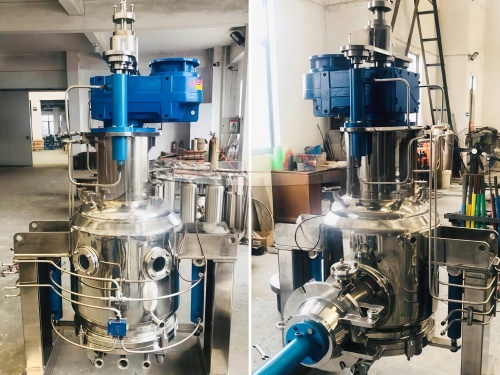
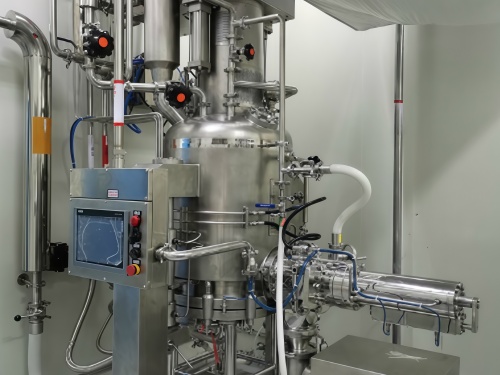
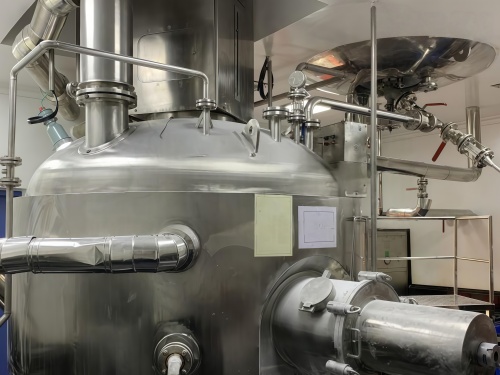

We provide design, research and development, production, and technical services for crystal filtration, washing, and drying equipment, and are committed to undertaking refining and purification projects for fine chemicals, pharmaceuticals and their intermediates, flammable, explosive, and highly toxic special chemicals.
-
Product
-
Case
Contact
Welcome to contact us!
Tel:13861731823

 备案号:备案号:苏ICP123456789
